What Is Autonomous AI? How AI Agents Take a Goal and Do the Work
Autonomous AI is artificial intelligence that is given a goal rather than a single question, and works out and carries out the steps itself: it plans, uses tools, checks what happened, and adjusts until the work is done. Here is what that means, how it differs from chatbots, copilots and scripted automation, the levels of autonomy, and the controls that make it usable in a regulated organization.
For most people, AI still means a chat window: you ask, it answers, and you do the work. Autonomous AI changes who does the work. You give it an outcome (draft the quarterly risk report from these sources, reconcile these two ledgers every Monday, fix the failing test in this repository) and it decides the steps, uses the tools it has been allowed, looks at the results and keeps going until the outcome is reached or it has to stop and ask. That shift is why autonomous AI matters, and also why the question of control becomes the first question rather than the last.
Autonomous AI, in one sentence
Autonomous AI is AI that pursues a goal over many steps on its own: it plans, acts through tools, observes the result, and decides the next step, without a person directing each one. Underneath, it is a loop. A language model reads the goal and everything it has learned so far, chooses an action (read a file, query a database, run a command, write a document, hand part of the job to another agent), the system carries the action out, and the result goes back into the next decision. The loop ends when the goal is met, when the agent reaches a point where a person must decide, or when it cannot make progress. What makes it autonomous is not the model alone. It is the combination of a capable model, real tools to act with, and permission to use them.
Autonomous AI vs chatbots, copilots and automation
The easiest way to see the difference is to ask three questions of any system: who decides the steps, who does the work, and what happens when something unexpected comes up.
Kind of system
Who decides the steps
Who does the work
When something unexpected happens
Chatbot
The person
The person, using the answer
The person works it out
Copilot or assistant
The person
The person, with suggestions inline
The person works it out
Scripted automation (RPA, workflows)
Whoever wrote the script, in advance
The script
The script fails or stops
Autonomous AI
The AI, toward a goal a person set
The AI, through the tools it is allowed
The AI adapts, or stops and asks a person
Autonomous AI is not a better chatbot. It is a different arrangement of responsibility: the person moves from doing each step to setting the goal, approving what matters, and reviewing the result.
Levels of autonomy
Autonomy is not on or off; it is a dial. A practical way to describe it, borrowed loosely from the way self-driving cars are graded, has five steps. Level 0, answer: the AI responds and does nothing else. Level 1, suggest: it proposes an action and a person carries it out. Level 2, act with a check on each step: it carries out actions itself, but a person approves every one. Level 3, act within boundaries: it reads, researches and prepares freely inside the scope it was given, and stops for a person only before anything that changes something that matters. Level 4, unattended: it works without anyone in the loop. Most enterprise work belongs at level 3. Level 2 is too slow to be worth it for long tasks, and level 4 removes the person who is answerable for the outcome. The useful question for any system is therefore not "is it autonomous?" but "which actions does it take alone, which wait for a person, and who decides that?"
What autonomous AI does in an organization
The work that suits autonomous AI has a clear outcome, many small steps, and sources the AI can read. Documents: drafting, reviewing and rewriting reports, policies, contracts and memos from the material it is given, delivered as files. Data: answering questions over the organization’s databases and files, showing the query it ran and checking the numbers against what it actually read. Research: reading what it is pointed at and reporting its sources. Operations: recurring checks, reconciliations and reports that run on a schedule. Software: reading code, planning a change, editing it as a reviewable diff, running the tests. And delegation: splitting a large job among several agents and returning one answer. In each case the value is the same. The hours go from doing the steps to deciding what should be done and checking that it was.
The risks, and the controls that answer them
An AI that acts can act wrongly, and that is the whole risk in one line. It can change the wrong record, run the wrong command, or send something where it should not go. It can be misled by text inside a document or web page it reads, written to steer it (prompt injection). And when it works for an hour across fifty steps, nobody may be able to say afterwards exactly what it did. Each risk has a control, and a serious system has all of them, enforced by the server rather than promised in the interface. Scope: the AI reaches only the folders, databases and systems it was given. Approval: anything that changes something important waits for a person, and the server, not the model, decides which actions those are. Egress: no outbound connection unless policy allows it, so material it reads has nowhere to go. Record: every step, tool call and approval kept in a tamper-evident log that a reviewer can check later. And a stop: a person can end the run at any point.
How NeueCode does it
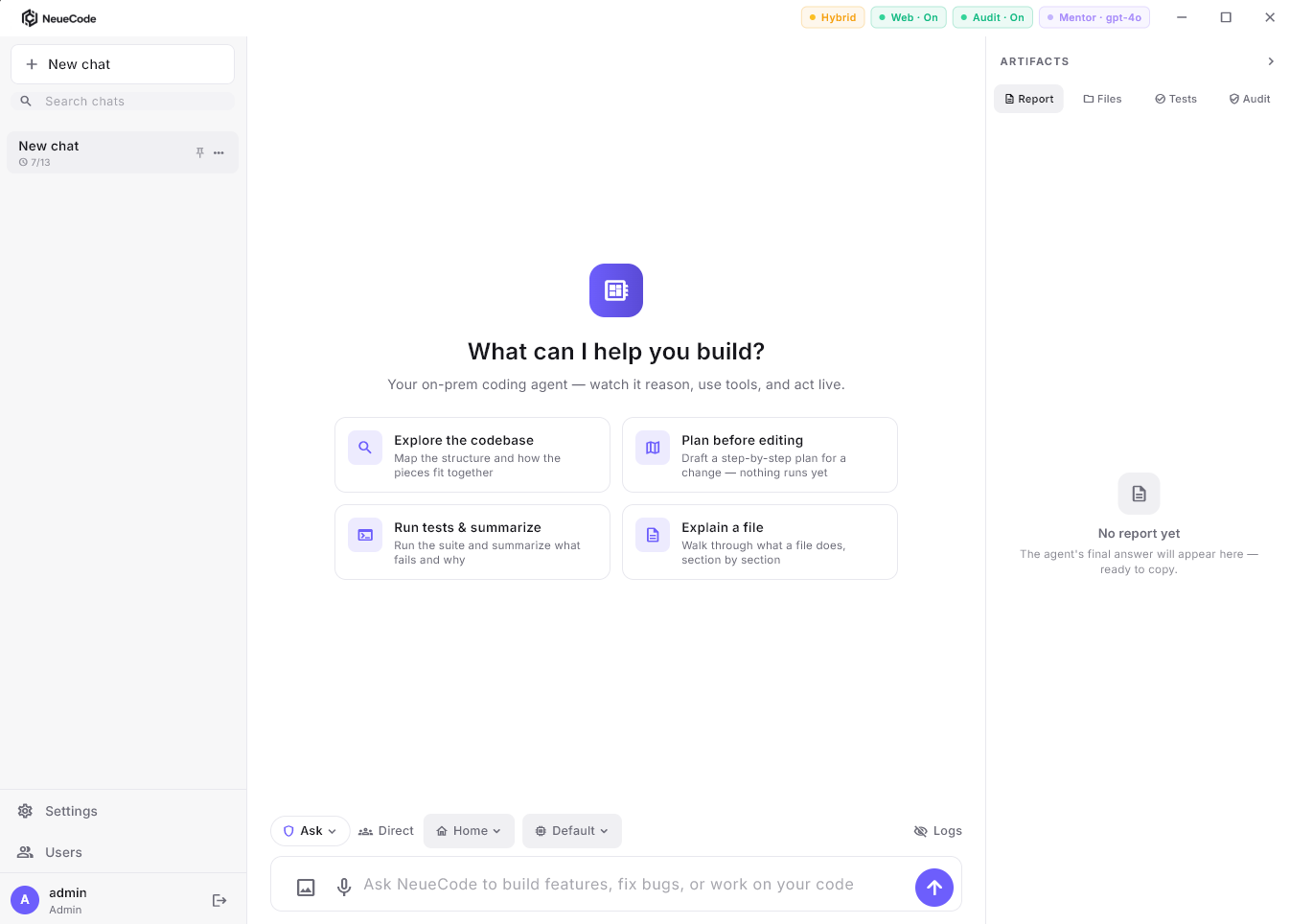
NeueCode is private autonomous intelligence for the enterprise: autonomous AI that runs on one server inside your network, on your own NVIDIA GPUs, with open-weight models, so no vendor cloud is in the data path. It takes the work above (documents, data, research, operations, software and delegation to sub-agents) and does it itself. The controls are built into the server. Strict mode is how a new installation starts: no outbound connection, with web access and cloud models off. The server decides which actions wait for a person (changes outside the project, administrator commands, plans), and administrator commands always wait. Every step, tool call and approval is kept in a tamper-evident record, with a signed per-run manifest an auditor can verify offline. NeueCode is not certified against any framework; its evidence is mapped, not certified, to frameworks such as NIST AI RMF, ISO/IEC 42001 and the EU AI Act.
Frequently asked questions
What is autonomous AI, in one sentence?
Autonomous AI is artificial intelligence that is given a goal and works out and carries out the steps itself: it plans, acts through tools, checks the result and adjusts until the work is done or a person has to decide.
Is autonomous AI the same as agentic AI?
Mostly, yes. "Agentic AI" describes how the system works (an agent that plans and uses tools in a loop); "autonomous AI" describes how much it does without a person. An agentic system can run at a low level of autonomy, with a person approving every step, or at a higher one.
How is autonomous AI different from generative AI?
Generative AI produces content (text, code, images) in answer to a prompt. Autonomous AI uses a generative model as its reasoning engine, but adds tools and a loop, so it can take actions toward a goal instead of only producing a reply.
Does autonomous mean no human is involved?
No. In an organization, a person sets the goal, the boundaries decide what the AI may reach, and anything that changes something important waits for a person’s approval. Autonomy removes the person from each routine step, not from responsibility for the outcome.
Can autonomous AI run on-premises, without the internet?
Yes. With open-weight models on the organization’s own GPUs, the model, the tools and the record all stay inside the network. NeueCode runs this way on one server, and after installation it works without internet; strict mode, the default, allows no outbound connection at all.