Autonomous AI governance: control for AI that acts, not only advises.
Autonomous AI governance is the control of AI systems that act rather than only advise: every action an AI agent takes runs under a policy the organization sets, the risky ones wait for an approval it controls, and all of it leaves a record an auditor can verify without trusting the vendor.
Frameworks tell an organization which controls it needs. Governing autonomous AI is enforcing those controls while the agent is actually running.
Why does autonomous AI need its own governance?
Classic AI governance manages models that predict. An agent does not predict; it does.
It acts with delegated authority
An AI agent writes documents, queries databases, runs commands, changes systems and calls APIs, with the credentials of the person who launched it. Access control decides who may enter; it says nothing about what happens next.
It acts faster than review
One task can mean a long chain of actions in sequence. Reviewing them afterwards is not governance; it is forensics. The control has to sit in the path of the action, before the consequence.
It has to be provable, not just logged
A log the vendor or an operator can edit is a claim. Regulated organizations need a record that shows tampering and that an auditor can verify offline, without trusting anyone who ran the system.
Start from the definition: What is Govern AI?
What is AI agent governance?
AI agent governance is the set of runtime controls that decide what an AI agent may do, who must approve it, and how every action is recorded: the policy, approval and evidence layer around autonomous agents.
The market uses the two terms interchangeably. “Autonomous AI governance” names the problem: AI that acts. “AI agent governance” names the unit being governed: the agent. NeueCode 7 treats them as one discipline, because the only place either can be enforced is in the path of the agent's actions.
What does autonomous AI governance consist of?
Five controls. Each has to exist at runtime, in the path of the action, and each has a concrete form in NeueCode 7.
- 1
Decide what agents may do
A deny-by-default list of capabilities, set per organization and per role, checked on every tool call.
In NeueCode 7: A governance console with a deny-by-default capability registry that ships locked down with a fail-closed floor; every class toggles org-wide and per role, with least-privilege checks on every call.
- 2
Approve before consequence
Actions that change state pause for a human. The highest-risk ones need two.
In NeueCode 7: Write, shell, commit and database changes pause for approval as reviewable diffs; break-glass dual control enforces a two-person rule, and single-admin self-approval is recorded distinctly and raises an alert.
- 3
Bound the run
Limits on how far and how long an agent may go, and a hard line between instructions and data.
In NeueCode 7: Hard iteration, token and wall-clock budgets per run; untrusted tool, web and memory content is fenced as data, not instructions; a deterministic verifier checks the agent's claims against what its tools actually returned.
- 4
Keep the AI where the data is
The governed system runs on infrastructure the organization controls, and what leaves the network is a policy decision, not a default.
In NeueCode 7: On-premise or air-gapped on your GPUs, with local open-weight models. Three deployment modes switch live; in strict mode a deny-by-default egress broker makes the agent's cloud and network paths structurally unreachable, and a secret scan blocks credentials before any socket opens. The AI Governance Gateway extends the same policy to Copilot, Cursor and Claude Code: every outbound prompt is scanned, classified, allowed, redacted or blocked, then signed into the audit trail.
- 5
Prove it
A record that shows tampering, and evidence a third party can verify without trusting the vendor or the operators.
In NeueCode 7: The Agent Flight Recorder keeps a tamper-evident, hash-chained record of every step, tool call and approval; each run emits a signed non-egress manifest; auditors verify both offline; and a compliance portal exports evidence mapped to EU AI Act Articles 12, 13 and 14, DORA, NIS2, SOC 2 CC6 and ISO 42001 — a mapping, not a certification.
THE GOVERN AI DASHBOARD
One number for how well your AI is governed.
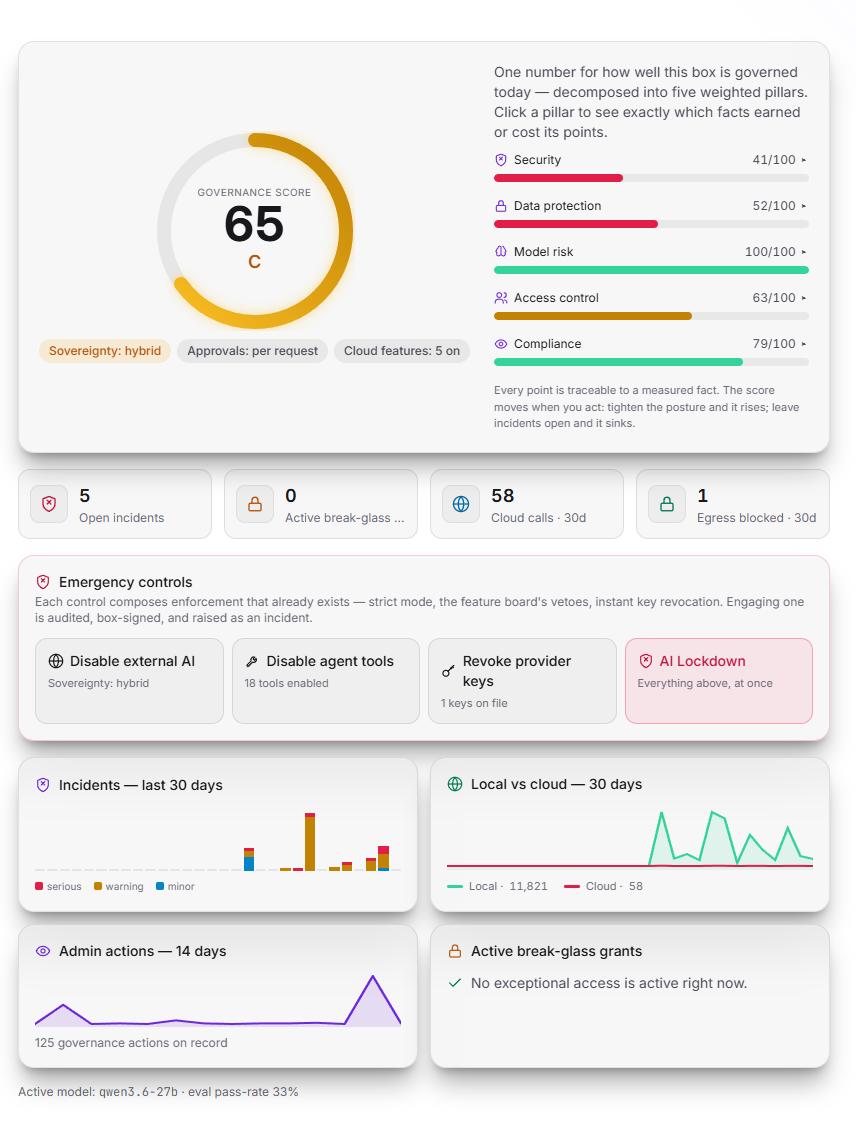
A real capture from NeueCode 7 — a governance score computed from the box in front of you, not from a brochure.
Five weighted pillars
Security, data protection, model risk, access control, and compliance — every point traces to a measured fact, and the score moves when you act.
Emergency controls
Disable external AI, disable agent tools, revoke provider keys — or engage AI Lockdown for everything at once. Every activation is audited, signed, and raised as an incident.
Full operational visibility
Local-vs-cloud calls, active break-glass grants, open incidents, and admin actions — one pane, in English and Arabic.
How does it map to NIST AI RMF, ISO/IEC 42001 and the EU AI Act?
Frameworks describe outcomes. The table shows the runtime control that produces each one.
| Framework | What it asks for | The runtime control |
|---|---|---|
| NIST AI RMF (United States) | Govern, Map, Measure, Manage: accountability, documented context, measured risk and treated risk across the lifecycle. | Capability registry and approvals (Govern); per-run budgets and deployment modes (Map); the verifier and evidence export (Measure); dual control and eval-gated model rollback (Manage). The NIST AI RMF page |
| ISO/IEC 42001 | An AI management system: policy, roles, operational controls, monitoring and continual improvement. | Org-wide and per-role policy in the registry; the Flight Recorder as the monitoring record; evidence export mapped to ISO 42001. |
| EU AI Act, Articles 12, 13 and 14 | Record-keeping, transparency to deployers, and effective human oversight. | Hash-chained logs, reviewable diffs, approval on risky actions and break-glass dual control. |
| DORA and NIS2 (European Union) | ICT risk management and incident evidence for financial entities and essential services. | Signed per-run manifests and the exportable audit trail. |
NeueCode provides technical controls and audit evidence that support your governance and compliance program. It does not certify you against any framework, and no framework body endorses it. A mapping, not a certification.
How is this different from an AI governance platform?
A governance layer beside the agents
Most AI governance platforms sit beside agents built elsewhere: they discover them, monitor them, and apply policy from outside, usually from the cloud. That is useful when the agents already exist, but the record is then a report of the action rather than the action itself.
One governed system: build it, run it, govern it, prove it.
NeueCode 7 takes the other route: it builds the engineering agents, serves local open-weight models on your GPUs, and governs every action inside one system on one server. The record covers the action itself, and the whole thing runs air-gapped. Cloud governance is not wrong; it is a different answer to where control should live, and regulated organizations get to answer that on their own terms.
A detailed comparison with a runtime-enforcement layer: NeueCode vs PUMAS
Who needs autonomous AI governance first?
Any organization letting AI act on systems it is accountable for. The need arrives first where that accountability is regulated: banks, government and defense, critical infrastructure, healthcare, telecom, and the integrators that deliver into them, in the United States and other regulated markets.
Frequently asked questions
- What is autonomous AI governance?
- Autonomous AI governance is the control of AI systems that act rather than only advise: every action an AI agent takes runs under a policy the organization sets, the risky ones wait for an approval it controls, and all of it leaves a record an auditor can verify without trusting the vendor.
- How is it different from AI governance in general?
- Classic AI governance manages models that predict: bias, accuracy, documentation, lifecycle. Autonomous AI governance manages systems that take actions with delegated authority, so enforcement has to happen at runtime, in the path of each action, not in a review afterwards.
- Is it the same as access control?
- No. Access control decides who and what may enter a system. Governance decides what may happen once inside, who approves it, and how it is proven. An agent with valid credentials and no governance is unsupervised on your own hardware.
- Can it govern GitHub Copilot, Cursor and Claude Code?
- Yes. The AI Governance Gateway in NeueCode 7 lets those tools use NeueCode as their model endpoint. Every outbound prompt is scanned, classified and policy-checked (allow, redact or block), then signed into the audit trail before any upstream call, so the tools developers already use inherit the organization's policy and record.
- Does it work air-gapped?
- Yes. NeueCode 7 installs on your own GPUs with local open-weight models and does not phone home. In strict mode the agent's cloud and network paths are made structurally unreachable, and the verifier tools that check the evidence run offline.
- Does NeueCode certify compliance with NIST AI RMF, ISO 42001 or the EU AI Act?
- No. NeueCode maps its controls and evidence export to those frameworks so your compliance team has a starting point. It is a mapping, not a certification, and no framework body endorses NeueCode.
- What is AI agent governance?
- AI agent governance is the set of runtime controls that decide what an AI agent may do, who must approve it, and how every action is recorded: the policy, approval and evidence layer around autonomous agents. In practice it is the same discipline autonomous AI governance describes, seen from the agent's side.
- How do you govern autonomous AI?
- Put the controls in the path of the action: a deny-by-default capability list, human approval before state-changing actions, hard budgets on each run, a boundary on what the agent can reach, and a tamper-evident record. If any of those five sits outside the runtime, it is documentation, not governance.
- How do enterprises control AI agents in practice?
- Through four decisions: where the agent runs, what it may reach, which actions need a person, and what evidence is kept. NeueCode 7 makes all four configuration, switchable live, and records the answers with every run.
- How do you prevent an AI agent from exfiltrating data?
- Assume it will try, by mistake or by prompt injection, and make egress structurally impossible rather than merely forbidden: run it on your own infrastructure, put a deny-by-default broker between it and the network, scan for secrets before any socket opens, fence untrusted content as data, and sign a per-run manifest showing nothing left. In NeueCode 7's strict mode that is the default state; the signed manifest covers the agent's own code paths, and a packet-level guarantee is an optional OS-tier layer.
- How do you audit autonomous AI actions?
- With a record the operators cannot quietly edit. NeueCode 7's Agent Flight Recorder hash-chains every step, tool call and approval, storing actions and byte-sizes rather than code, prompts or reasoning, so auditors can verify the chain offline without trusting NeueCode or your operators, and export evidence mapped to the frameworks they report against.
See the system that runs it.
NeueCode 7 is the platform built to enforce this on your infrastructure. Walk through the product, or install it on your own server and try it free for 30 days.